How we screwed up Onboarding. And fixed it.
Client
Founders.One · Case Study
Year
2023
Product: A platform that connects early-stage startups with investors, focusing on projects at the idea or initial development stage.
Problem: Most users didn't complete onboarding, and project profiles remained empty, making the platform feel abandoned.
Cause: Founders are overwhelmed with registrations on multiple platforms and don't have the time or energy for long forms. They also struggle to articulate their project details effectively.
Solution: Removing artificial restrictions, integrating AI to auto-fill project profiles from existing materials, and redesigning the onboarding flow around minimal effort.
My role: Lead Product Designer (team of 5: PM, 3 developers, designer). I owned UX research, interaction design, and the AI-assisted onboarding concept.
Scope of Work


We outplayed ourselves
Our original onboarding was a textbook example of how not to do it. The business needed to gather as much information as possible about founders' projects, so the sign-up process felt like a full-blown quest with a dozen steps. We assumed that founders would be willing to spend 15 minutes filling out a form if it meant attracting investors.
We were dead wrong.
After interviewing 12 users (both active and those who dropped off) and cross-referencing with our analytics funnel, we found that 80% never completed onboarding, and 30% bounced on the first screen when they saw the number of steps ahead.
The reason wasn't the questions themselves. It was exhaustion. Startup founders are constantly pitching to investors, filling out applications, and registering on platforms, most of which lead nowhere. By the time they landed on ours, the sight of another long form was enough to make them quit before starting.


First iteration: the quick wins that weren't enough
We started with the basics:
Cut the sign-up process to bare essentials
Added motivational nudges to complete profiles later
Introduced completion rewards. Users earned points for filling out sections
The biggest change: we removed the gate. Previously, users couldn't create a project until their personal profile was fully set up. We dropped that restriction. Now anyone could create a project regardless of how much personal info they'd provided.
Result:
onboarding completion for user profiles improved, more people got into the platform. But the projects? Still empty. Founders struggled to articulate their ideas, lacked visuals, and put off filling out project details indefinitely. Completion rewards had no measurable effect on project profiles. People earned points but left the actual content blank.
The result was a graveyard of half-finished projects and disengaged users. We'd moved the bottleneck, not removed it..
The real fix: just do it for them
Our lead engineer had a favorite saying: "If something can be skipped, skip it." So we asked ourselves: why motivate users to fill out forms when we could fill them out for them?
Most startups already have pitch decks, landing pages, or profiles on Product Hunt. The information we needed was already out there, just scattered across different platforms.
We researched the most common places founders pitch their projects (Product Hunt, LinkedIn, AngelList, personal landing pages) and identified which data points we could extract automatically. Then we built an AI-powered pipeline: the system analyzed uploaded documents, websites, and presentations, scraped public mentions of the project, and structured everything into a project profile.
This was early 2023, before AI-assisted onboarding became a common pattern. We had no playbook to follow, which meant a lot of experimentation with what LLMs could reliably extract and what they'd hallucinate. We considered alternatives: template-based profiles (low effort but generic) and manual curation by our team (accurate but unscalable). AI extraction was a higher upfront investment, but it scaled without headcount.
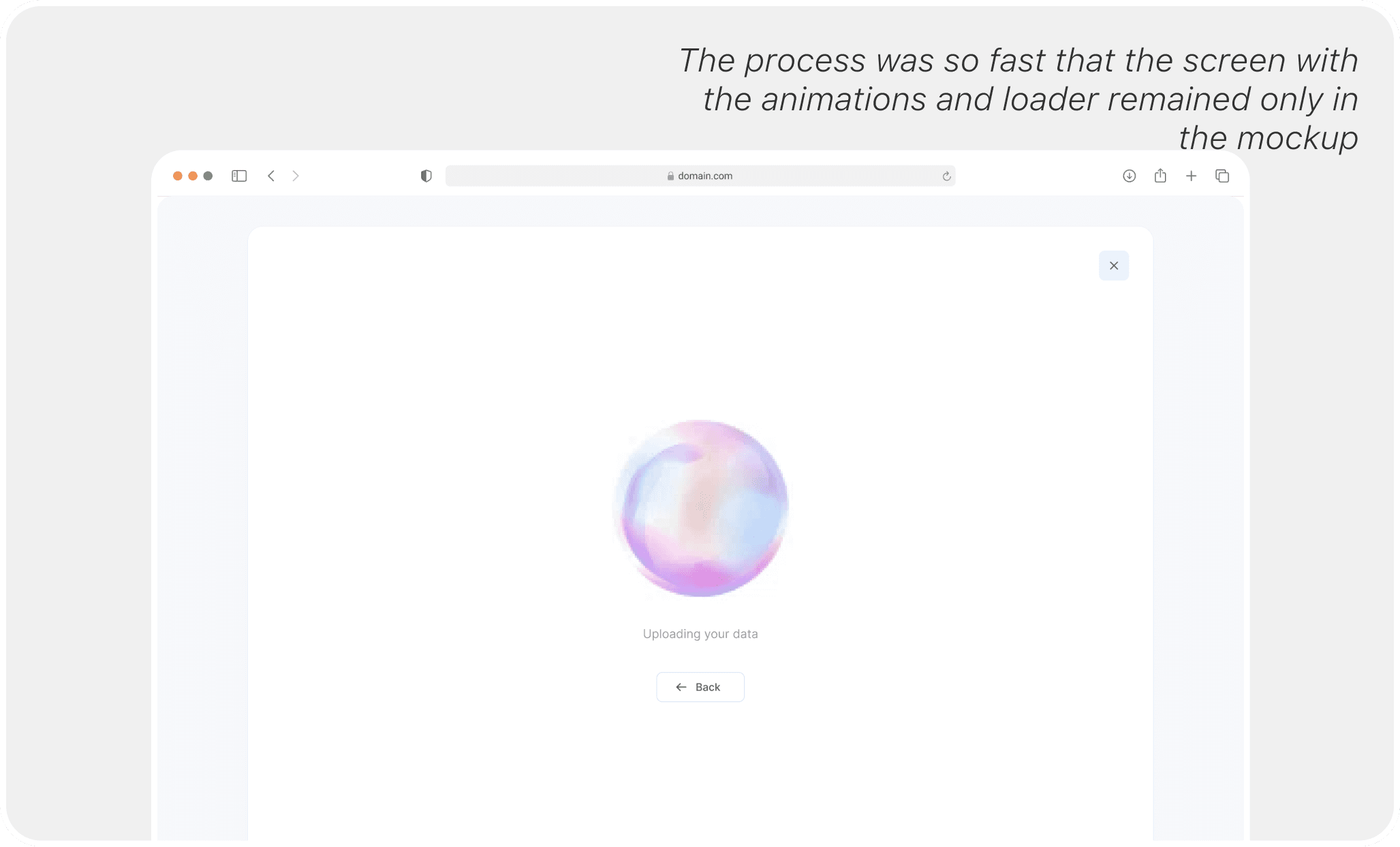
All users had to do was drop a link, and their project profile was populated automatically. They could review and edit everything before publishing.

The Outcome
Of course, not everyone was comfortable uploading pitch decks. Some worried about data leaks, others simply didn't have polished materials. For them, we kept a stripped-down manual flow with AI assistance at every step: the system suggested descriptions, categories, and market positioning as the user typed.
The results:
75% of new users (out of ~200 in the first month post-launch) uploaded at least one link, compared to near-zero project completion before
Project profiles went from an average of 2 out of 12 fields filled to 8 out of 12
Onboarding completion rose from 20% to approximately 55%
As a bonus, founders actually enjoyed interacting with the AI. Several mentioned it in feedback as the moment the platform "clicked" for them
What didn't fully work: idea-stage founders, our primary audience, often had no existing materials to upload. For them, the AI pipeline was less useful, and the manual flow carried the weight. This is where we would have iterated next.
The visual materials shown here are from the first iteration after we committed to the AI approach. The final shipped version is under NDA. I've recreated key screens to illustrate the flow.

Final result
Unfortunately I can't show the latest version, due to the terms of the agreement with the company. But I'm showing the version that was made as the first one, after we decided to start onboarding.


What I took from this
We didn't just fix onboarding. We changed how we thought about user effort. The insight that carried forward: don't ask users to describe what already exists elsewhere. Find it, structure it, and let them correct you.
When research shows something isn't working, it's probably not the research that's wrong. It's you.